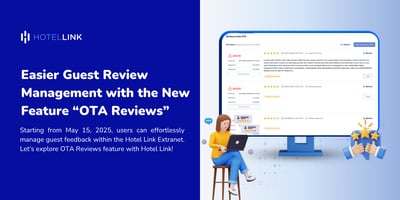
Hotel Link is proud to officially launch the OTA Reviews feature – a powerful solution that allows...
Just a few minutes after checking out, a guest's 1-star review on Google can completely cause ChatGPT or Gemini to exclude your hotel from the recommendation list for the next traveler. In the era of AI Search, review sentiment directly dictates visibility and revenue. Hotel Link has compiled in-depth analyses alongside proven Service Recovery strategies to help hotels transform complaints into long-term loyalty and build brand authority across AI platforms.
The Service Recovery Paradox: Why Mistakes Can Create More Loyal Guests

The concept of the Service Recovery Paradox was proposed in 1992 by researchers Michael McCollough and Sundar Bharadwaj, describing a counterintuitive phenomenon: a customer who experiences a service failure that is resolved brilliantly sometimes rate the business higher than if no failure had occurred at all.
The psychological mechanism behind this is straightforward:
- When an issue occurs, the guest's expectations are temporarily lowered.
- If the hotel responds swiftly, sincerely, and resolves the issue satisfactorily, that experience far exceeds their reduced expectations, instilling a sense of being valued and trusted.
According to analysis from Harvard Business Review, customers who experience excellent service recovery processes record an 8% higher loyalty rate on average compared to those who faced no issues at all. However, this paradox does not happen automatically. The effectiveness of service recovery relies heavily on the manner and speed of resolution. A superficial apology or delayed compensation can easily backfire, driving guests away instead of building loyalty.
Response Speed: The Decisive Yet Often Neglected Factor
A study by Coyle Hospitality Group, analyzing over 11,000 data points across 525 surveys at luxury hotels, revealed a striking operational gap: while other service recovery elements achieved completion rates between 74% and 97%, only 68% of service recovery cases were completed within the timeframe expected by the guest.
This gap explains why many hotels still lose guests despite having structured complaint-handling procedures. The problem is not whether the issue is resolved, but how fast it is resolved.
For hoteliers, this establishes practical operational principles:
- Specific Timeframes: Set strict response SLAs for each complaint type (e.g., acknowledgement within 15 minutes, on-site resolution within 2 hours).
- Frontline Empowerment: Authorize reception and housekeeping staff to independently offer minor compensations (e.g., complimentary drinks, room upgrades) without waiting for multi-level management approvals.
- Track Resolution Time: Monitor real-world resolution speed as a daily operational KPI.
How the AI-Search Era Changes the Game
The Phocuswright Travel Innovation & Technology Trends 2026 report highlights that over 58% of active travelers utilize AI in their travel journey, with 39% specifically using AI for research and stay planning. AI Search is no longer an experiment; it is actively replacing traditional search engines.
Even more notable is how these AI models "read" review data to determine recommendations:
- The Power of Ratings & Volume: An analysis on Hospitality Net (2026) testing 12 AI models randomly showed that when a hotel's review score increased from 3.9 to 4.7 stars, the probability of being recommended by AI jumped by 31.6 percentage points; a higher review volume contributed an additional 8.3 percentage points.
- Citations from Real Experience Sources: A study examining 1.357 Gemini citations across 156 hotel-related queries revealed that experiential searches (e.g., "hotels with great service recovery, family-friendly") pulled 55.9% of their citations from non-OTA sources (like Google Reviews), compared to only 30.8% for purely transactional price searches.
Decoding the Algorithm: Why AI Search "Blacklists" Hotels with Bad Reviews
To understand why a 1-star review about noise or poor service attitude can make a hotel completely "vanish" from ChatGPT, Gemini, or Perplexity answers, we must look into how Large Language Models (LLMs) process and retrieve guest experience data:
1. Multi-Source Data Ingestion
Daily, AI Search crawlers aggregate public data across millions of sources: Google Reviews, TripAdvisor, Agoda, Booking.com, and personal social media posts. A single guest complaint is no longer an isolated incident on one platform; it instantly becomes part of the AI's training and retrieval dataset.
2. Aspect-Based Sentiment Analysis (ABSA)
Unlike traditional search engines that simply count keyword frequency, AI Search utilizes advanced Natural Language Processing (NLP) models to analyze sentiment per specific attribute:
- Subject Identification: AI reads beyond the overall star rating to pinpoint the exact cause of frustration. When a guest writes "The room was nice, but it was noisy at night and front desk was slow to respond", AI separates these clauses.
- Semantic Tagging: The algorithm attaches negative sentiment tags directly to specific operational metrics: Noise Level: High/Poor and Service Recovery Speed: Unsatisfactory.
- Sentiment Weighting: Reviews expressing intense anger, detailed disappointment, or repeated issues carry significantly higher negative weight than short, generic complaints.
3. Storage and Positioning in Vector Memory (RAG)
To deliver real-time answers, AI Search employs Retrieval-Augmented Generation (RAG) powered by vector databases:
- Every guest review is converted into mathematical representations of meaning (embeddings).
- Hotels with unresolved negative reviews are placed in a "high-risk data cluster" associated with poor stay experiences.
4. Contextual Filtering Based on User Prompts
When a traveler enters an experiential search query (e.g., "Recommend a quiet hotel with great service, suitable for families in Da Nang"):
- AI Search scans the vector space for attributes matching the request (Quiet, Good Service).
- If your hotel carries a negative tag for Noise or Poor Service Recovery in the recent RAG database, the algorithm will automatically filter out your brand in the first retrieval round.
- AI will not risk recommending a property that might disappoint its users, leading to your brand being completely "blacklisted" from thousands of potential searches.
In other words, an improperly handled complaint doesn't end with one unhappy guest. It morphs into negative input data stored permanently in algorithmic memory, directly eroding organic visibility and disrupting future hotel revenue.
A Standardized 4-Step Service Recovery Framework
To leverage the service recovery paradox without falling into slow or superficial responses, hoteliers should implement this standardized workflow:
- Step 1: Active Listening & Immediate Acknowledgement: Frontline staff must listen actively and log the exact details before offering solutions, avoiding interruptions or excuses.
- Step 2: Sincere Apology & Concrete Action: Generic apologies are unconvincing. They must be accompanied by clear corrective actions (room switch, refund, complimentary service).
- Step 3: Complete Resolution Within Expected Timeframes: Optimize on-site resolution speed to prevent issues from escalating into 1-star online reviews.
- Step 4: Post-Incident Follow-up: A quick message or call after the issue is resolved leaves a lasting positive impression, proving the hotel truly cares rather than just "closing a ticket."
Read more: Golden Opportunity for Hotels to Break Through by Addressing Negative Reviews
Traditional Complaint Handling vs. AI-Era Service Recovery
| Feature | Traditional Incident Handling | Service Recovery in the AI-Search Era |
| Core Objective | Suppress complaints on-site, minimize immediate costs | Convert angry guests into Brand Advocates & Optimize AI Sentiment Score |
| Resolution Speed | Slow, requires multiple managerial approvals | Instantaneous; frontline empowered to resolve within expected timeframes |
| Online Response | Template-based, canned responses | Personalized responses detailing concrete action steps for AI data ingestion |
| Brand Impact | Affects only one direct customer | Determines recommendation likelihood on AI engines (ChatGPT, Gemini, Perplexity) |
| Data Logging | Manual logging or ignored post-checkout | Synchronized into PMS/Review systems for personalization & AI algorithm training |
Turning Review Responses into Signals for AI Search Engines
Beyond on-site resolution, how a hotel publicly responds to online reviews has become a core component of modern SEO strategies. Analysis from ROI300 shows that core search algorithm updates heavily prioritize content reliability and context.
Additionally, the Navigating AI 2026 report by Canary Technologies notes that a hotel moving its TripAdvisor ranking from position 20 to position 10 in a region can record a 20% to 30% increase in bookings without changing room rates.
To turn review responses into true visibility assets, hoteliers should:
- Respond at Lightning Speed: Reply to all reviews (including positive ones) within 24 to 48 hours.
- Detail Specific Solutions: Explicitly address the issue mentioned and how it was fixed (e.g., "The hotel has installed new soundproofing systems on the 3rd floor"). AI models heavily favor factual, authentic content.
- Maintain Voice Consistency: Keep a professional brand tone across all channels (Google, Booking.com, Agoda, TripAdvisor) to build uniform data for AI collection.
Streamlining Guest Reviews with Hotel Link’s OTA Reviews Feature
Handling complaints and tracking feedback manually across multiple separate channels often leads to missed information or delayed responses. Recognizing the importance of guest experience management, Hotel Link provides the OTA Reviews feature to help hotels optimize their review tracking and response workflows:
- Centralized Review Aggregation: Automatically gathers all reviews from major OTA channels (Booking.com, Airbnb, Expedia, etc.) into a single, unified interface on the Hotel Link system.
- Swift Monitoring & Response: Allows operational teams to easily track, categorize, and respond to guest reviews directly on one platform without logging into individual OTA accounts.
- Accelerated Incident Handling: Minimizes the risk of missing negative feedback, helping hotels deliver timely resolutions and boost guest satisfaction.
To learn more about activating and operating this feature, check out our guide: Managing Guest Reviews Effectively with the New OTA Reviews Feature.
Conclusion
Handling guest complaints is no longer a simple reactive duty for the front desk. As AI continues to replace traditional search engines and increasingly relies on review sentiment to drive recommendations, every well-handled complaint, and every professional public response, builds both current guest loyalty and future AI search visibility.
Hotel Link empowers hotels across Southeast Asia with centralized review management via the OTA Reviews solution, helping operational teams monitor, respond to, and analyze guest sentiment instantly from a single platform.
Contact Hotel Link today for a 1-on-1 consultation and a free demo of our review management solution, and start turning service recovery into higher AI search visibility!
Learn more: How To Analyze Guest Feedback & Hotel Performance
References
- Canary Technologies. (2026). Navigating AI in hospitality 2026: The impact of review rankings on direct bookings. Canary Hospitality Reports. Cited via Ricci, T. M. (2026).
- Coyle Hospitality Group. (2018). The new service recovery paradox: Step it up with follow-up. Coyle Hospitality Research Reports. https://coylehospitality.com/research_reports/the-new-service-recovery-paradox-step-it-up-with-follow-up/
- Harvard Business Review. (2020). The business value of service recovery and customer retention. HBR Customer Experience Insights.
- Hospitality Net. (2026). Who owns the recommendation? AI-driven discovery and sentiment weighting in hotel search. Hospitality Net Opinion. https://www.hospitalitynet.org/opinion/4133918/who-owns-the-recommendation
- Hotel Link Solutions. (n.d.). OTA Reviews, PMS & Channel Management Solutions for Independent Hotels. https://www.hotellinksolutions.com/
- Hotel Online. (2025). The customer service recovery paradox: Turning guest complaints into brand advocates. Hotel Online News. https://www.hotel-online.com/news/the-customer-service-recovery-paradox
- McCollough, M. A., & Bharadwaj, S. (1992). The service recovery paradox: An empirical investigation. Journal of Services Marketing, 6(4), 23-32.
- Phocuswright. (2026). Travel forward: Data, insights and trends for 2026. Phocuswright Travel Research. https://www.phocuswright.com/Travel-Research/Research-Updates/2026/Travel-Forward-Data-Insights-and-Trends-for-2026
- Ricci, T. M. (2026). AI for hospitality: The complete industry guide 2026. Tommaso Maria Ricci Industry Insights. https://www.tommasomariaricci.com/blog/ai-for-hospitality-industry-guide
- ROI300. (2026). The definitive guide to Google hotel reviews and local SEO: Algorithmic authority, guest psychology, and technical optimization in 2026. ROI300 Hotel Marketing Insights. https://roi300.com/google-hotel-reviews/
- ScienceDirect. (2019). Joint effect of service recovery types and times on customer satisfaction in lodging. International Journal of Hospitality Management, 82, 112-120. https://www.sciencedirect.com/science/article/abs/pii/S1447677018302912
- Wikipedia. (n.d.). Service recovery paradox. Wikipedia, The Free Encyclopedia. Retrieved August 2026, from https://en.wikipedia.org/wiki/Service_recovery_paradox